
The shape, size and sagginess of your breasts can be one of the biggest insecurities for women. From a young age, you are told your body must look a certain way. So it is natural to feel insecure if your body doesn’t fit the mold.
But there is often a line between disliking your breasts’ look and having a real medical condition.
If you struggle with tuberous breasts, also called tubular boobs, your breast shape and projection may cause insecurity. You may already be considering tubular breast correction.
At New Birkdale Clinic, we have helped many women address insecurities with corrective breast surgery. In this guide, we explain what tuberous breasts are and how to treat them.
Keep reading to find out more.
What Are Tuberous Breasts?
Tuberous breasts, also called tubular or constricted breasts, are a congenital difference in breast development. It often becomes noticeable during puberty.
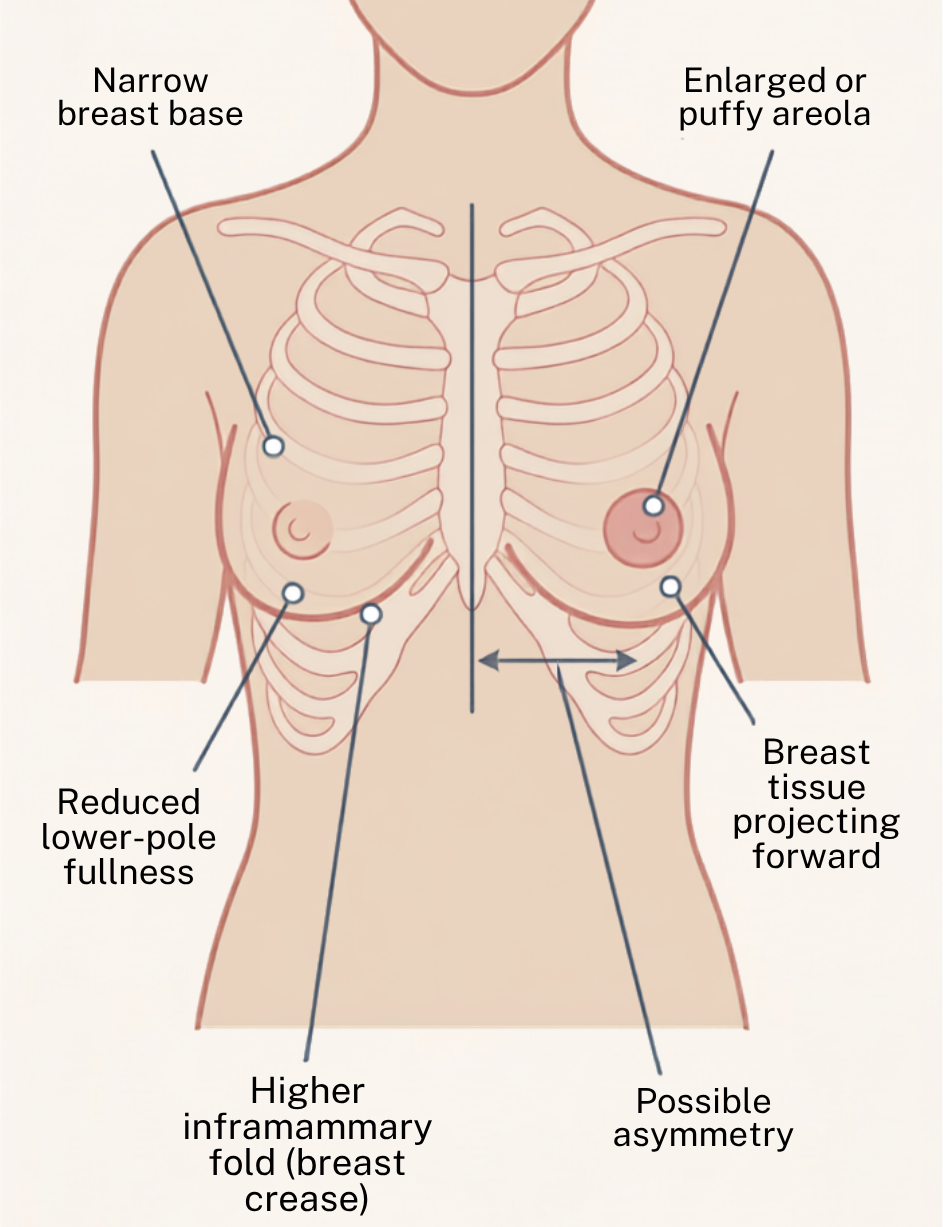
Instead of the standard rounded or teardrop shape, those with tuberous breasts have a narrow, tube- or cone-like shape.
What Causes Them?
Tubular breasts result from a congenital structural abnormality of the breast’s connective tissue that restricts normal growth and expansion during puberty.
Instead of developing a typical rounded breast shape, people with tuberous breasts have a tight or constricted breast base. This tightness pushes the developing tissue forward. It can result in a narrow, elongated, or cone-like shape.
As a result, glandular tissue herniates into the areola, making them appear puffy or enlarged.
It’s common for people with tuberous breasts to have asymmetry. One breast may be more affected than the other. Some people may have only one breast with this trait.
How Common Are Tuberous Breasts?
With many mild cases not diagnosed, no one knows the exact number of people with tuberous breasts, but it is estimated that 27% to 47% of people have the condition.
This means that if you have the condition, you’re not alone, and it is much more common than you might have thought. But if you still wish to undergo corrective surgery, there are solutions out there.
The 4 Grades of Tuberous Breasts
Tuberous breasts are grouped into four grades. The grades reflect how much tissue is missing. They also reflect skin shortage under the areola and constriction at the breast base. To understand which grade your breasts fall into, read the 4 criteria below.
Grade 1 – Mild
If you have less breast tissue in the lower inner quadrant, and your breast volume is almost normal, you are grade 1. The lower inner edge may look slightly pinched. The areola may point slightly inward or downward.
Grade 2 – Moderate
Grade 2 tuberous breasts are affected in both lower quadrants, but there tends to be adequate skin beneath the nipple. Moderate tuberous breasts tend to present as a normally developed upper half of the breast, but a lower half that lacks volume, and the areola points straight down.
Grade 3 – Severe
Severely tuberous breasts are affected in all lower quadrants of the breast, making the breast appear narrow, pinched at the base and sagging. This occurs because the skin under the areola hasn’t fully developed, and the areola often enlarges or herniates.
Grade 4 – Very Severe
Severe tuberous breasts are marked by tight constriction in the breast tissue and a small breast base.
This leads to a more pronounced elongation. All breast quadrants are underdeveloped, with tight, constricted skin and a much enlarged or herniated areola.
Tuberous Breasts vs Asymmetry vs Sagging
A lot of people are unsure of whether or not they’re suffering from tuberous breasts, asymmetry or sagging, but there are defined differences between all three.
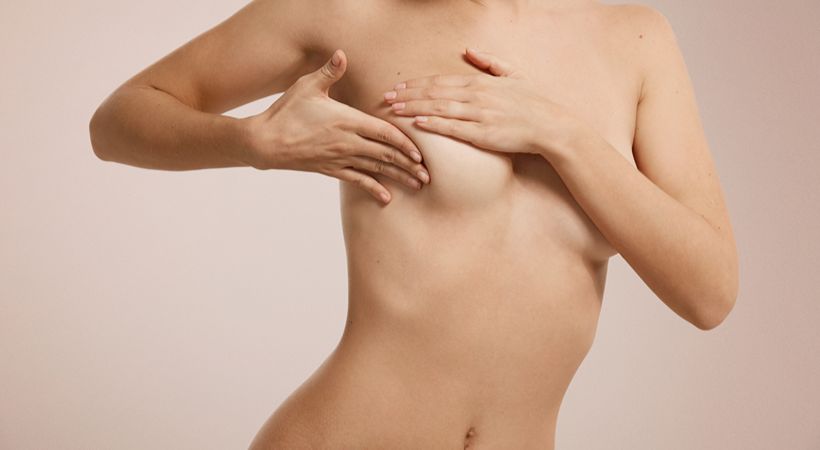
Tuberous breasts are a specific congenital shape that results from restricted tissue growth during puberty. In contrast, breast asymmetry refers to a size difference between the two breasts, which can be either normal or abnormal. Sagging, on the other hand, is the downward droop of normal breast tissue due to factors like gravity or ageing.
If you are sure that you would like to make changes to the shape of your breasts, book a consultation with our surgeons, and we can help you better understand your breast structure and the next steps forward.
Correction Solutions
If your tuberous breasts are making you feel insecure or generally affecting your confidence, don’t worry; there are ways to change the appearance of your breasts. These include:
Augmentation
A very common solution for tuberous boobs is breast augmentation. To fix tuberous breasts, you cannot depend on augmentation alone; it instead requires a specialised combination of breast augmentation, tissue release and reshaping, as the implants alone cannot fix the present structural constriction.
During this procedure, the surgeon cuts or scores the rigid internal fibres so that the lower part of the breast can expand. As part of the surgery, the surgeon also lowers the breast fold, helping create a more rounded proportion.
Once the base is ready, saline or silicone implants fill the lower quadrants to create a more rounded or teardrop shape. As part of the surgery, the areola is usually reduced or lifted to create a perkier appearance.
Uplift
If you have grade 1 tuberous breasts, you can use a breast uplift, or mastopexy, to help correct the appearance of your breasts. If you are happy with the size of your breasts or you’d simply like to change the shape, an uplift can be used to reshape the natural tissues without adding artificial volume.
Whether or not this will work for your breasts depends on the severity of your condition, and for some people, an uplift is simply not enough to achieve the desired end results. Meeting with one of our surgeons for a consultation is the best way to determine the right solution for your specific breast type, and they can guide you through your journey.
Fat Transfer
If you want a natural solution to reshape and add volume to your tuberous breasts, fat transfer, also known as autologous fat grafting, might be the solution for you. This is often combined with surgical release of tight, fibrous tissues to fully correct the deformity before the fat is transferred.
This is an alternative to using breast implants for those who wish to maintain a more natural appearance.

For a fat transfer, fat is removed via liposuction from another part of your body, processed to isolate healthy fat cells, and then strategically injected into the breast to fill hollow areas and help achieve a rounder shape.
Areola Reduction
One of the biggest insecurities experienced by those with tubular breasts is the size/protrusion of their nipples. During areola reduction and nipple correction, the surgeon will remove a ‘doughnut’ of excess skin and underlying tissue from the areola to help reduce the puffiness in that area. Again, to complete this procedure, a surgical release will be necessary to ensure that the tissue is properly distributed.
Areola puffiness typically differentiates this condition from asymmetrical or sagging breasts, as it often indicates underlying issues such as inflammation or hormonal changes, so surgeons try to address it to create a more balanced look.
Find Your Confidence With New Birkdale Clinic
Through this guide, you should now have a clearer understanding of what tuberous breasts are, what causes them and how you can fix them. At New Birkdale Clinic, we offer corrective surgery that can make a real difference. We can help you find the right solution from your first consultation.
You can also see indicative costs for each procedure on our breast surgery prices page before you commit to anything.
Are your breasts affecting your confidence, and do you want to do something about it? You’re in the right place, get in touch to find out how we can help you.


